Contributed by: TaylorC, FreeTaxUSA Agent

Congratulations on your new job! As you settle into a new routine, you may also wonder how the change will affect your taxes.
A new job can change how much federal income tax is withheld from your paycheck. It can also affect your total income, workplace benefits, and whether you owe money or receive a refund when you file your tax return.
Why Form W-4 matters
When you start a new job, your employer will ask you to complete Form W-4. This document tells them how much money to deduct from your paycheck for federal income taxes.
To understand why this form matters, it helps to know the difference between your tax withholdings and your actual tax liability:
Tax Liability: This is the grand total of federal income tax you actually owe for the entire year. This final number isn't determined until you file your tax return, because it is based on your total income from all sources, deductions, and tax credits.
Tax Withholdings: The U.S. uses a "pay-as-you-go" tax system. Withholdings are essentially pre-payments towards your final tax bill. Based on the instructions you provide on your W-4, your employer takes a portion of every paycheck and sends it directly to the IRS on your behalf.
When you file your tax return, you are simply settling the difference between what you already paid (your withholdings) and what you owe (your tax liability).
If your W-4 caused your employer to withhold less than your final tax liability, you will owe the IRS the difference. If your W-4 withheld more than your final liability, the IRS will return your overpayment to you as a tax refund.
Review your Form W-4 when your job, pay, filing status, dependents, or household income changes. The IRS also recommends completing a new Form W-4 when your personal or financial situation changes.
What if I have more than one job?
Working more than one job can make calculating your withholding more complicated. By default, each employer assumes they are your only source of income. For example, if you earn $50,000 from one employer and $75,000 from another, each employer may calculate your withholding based only on the wages they pay you, not your combined income of $125,000. As a result, the total withheld from all your paychecks may not cover your tax bill, particularly because some of your combined income may be taxed at a higher marginal rate. Any dollar earned above your deductions and withholdings will add to your tax liability. To prevent an unexpected balance due at tax time, you'll need to carefully coordinate the W-4s for each job.
Form W-4 Step 2 applies if you have more than one job at the same time. It also applies if you file a joint return and your spouse works. The 2026 form gives you three options:
- Use the IRS Tax Withholding Estimator, which is the most accurate option
- Complete the Multiple Jobs Worksheet (pg. 3 of Form W-4)
- Check the Step 2(c) box if there are only 2 jobs and the pay is similar
💡 Note: If you or your spouse has self-employment income, use the IRS Tax Withholding Estimator. The Form W-4 instructions recommend this option for a more accurate result.

What if you switch jobs?
If you leave one job and start another, you’ll likely receive a Form W-2 from each employer after the year ends. You’ll need both Form(s) W-2 when you file your tax return.
A job change can affect your withholding if your salary changes, you have a gap in employment, or you receive a signing bonus. A signing bonus is taxable income; the withholding on that paycheck may look different from the withholding on your regular paychecks.
Be sure to keep your pay stubs from both jobs. They will help you track your total earnings and the amount of federal income tax withheld during the year.
Changing jobs can also mean receiving other types of income. You may receive a bonus, severance pay, unused vacation pay, or unemployment compensation.
Keep in mind that the IRS generally considers all the following to be taxable:
Bonuses, severance, and vacation payouts: While employers may withhold taxes on these payouts at a different rate than your standard paycheck, they still count toward your total annual income.
Unemployment Compensation: This is also generally taxable. To avoid falling behind on your taxes, you can either choose to have federal income tax withheld directly from your unemployment checks, or you can make quarterly estimated tax payments.
How do benefits affect your pay and taxes?
Your new job may include benefits such as a 401(k)-retirement plan, health insurance, or commuter benefits. These perks can affect your take-home pay and, in some cases, your taxable income.
For example, premiums for health insurance and contributions to a traditional 401(k) are typically deducted pre-tax, meaning they lower your taxable income for the year. By contrast, Roth 401(k) contributions are made after-tax, meaning they do not reduce your current taxable income.
Compare your full pay package, not just your hourly wage or salary. Your benefits, retirement contributions, and tax withholdings all play a part in the amount you actually take home for each pay period.
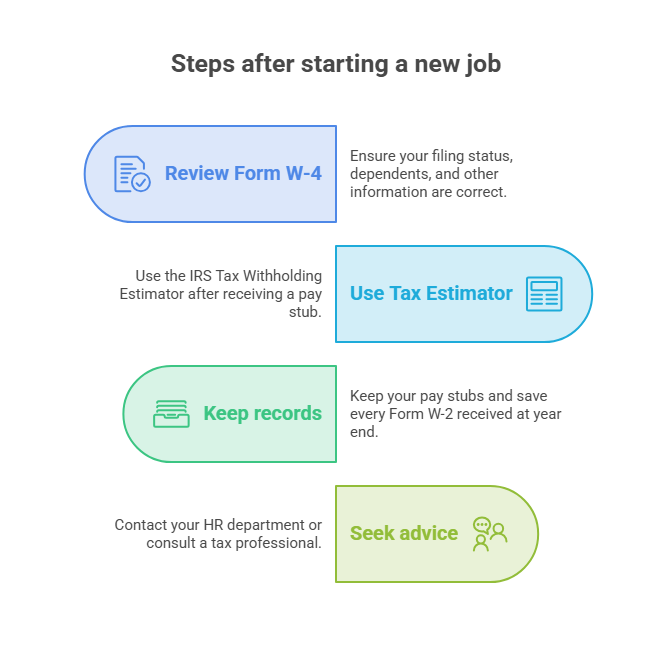
What should you do after starting a new job?
After you start a new job, review your Form W-4 as soon as you can. Make sure your filing status, dependents, and other information are correct.
Use the IRS Tax Withholding Estimator after you receive a pay stub, especially if you have more than one job, a working spouse, self-employment income, or a major change in pay. The estimator can help you decide whether you need to update your Form W-4.
Keep your pay stubs and save every Form W-2 you receive. If you’re unsure how a job change will affect your return, feel free to reach out to your employer's HR department or to consult a tax professional for advice about your specific situation. FreeTaxUSA customer support agents are happy to answer questions about your tax liability when you file with us.
While starting a new job doesn’t always drastically change your tax situation, a quick withholding check is the best way to help you avoid a tax surprise at tax time.