Contributed by: LynR, FreeTaxUSA Agent, Tax Pro

As you approach retirement, you may be wondering how your different sources of retirement income will be taxed. Understanding this can help you prepare so you avoid big surprises come tax time. Below are the main types of retirement income and how they’re taxed.
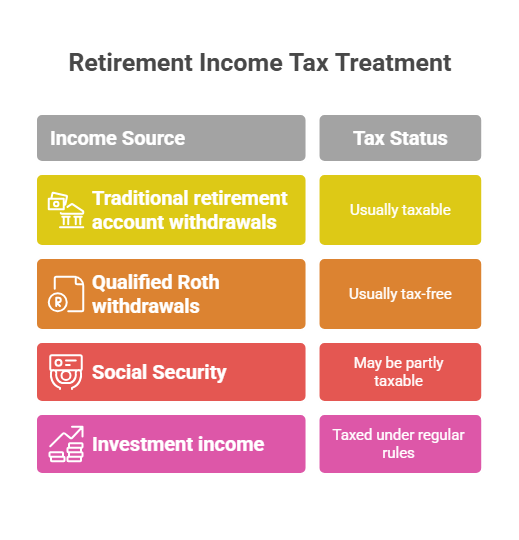
Traditional IRAs and 401(k)s
Since these accounts are usually funded with pre-tax dollars, distributions from traditional IRAs and 401(k)s are generally taxed as ordinary income at your current income tax bracket.
However, there’s an exception. If you didn’t take a tax deduction in a prior year, or you made a nondeductible contribution to your traditional IRA in a previous year, then a portion of your distribution will not be considered taxable. In this case, only the earnings portion of your distribution is considered taxable.
Roth IRAs and Roth 401(k)s
Contributions to these accounts are made with after-tax dollars. So qualified distributions are generally not taxable.
A distribution is usually qualified when the account has been open for at least 5 years and you’re age 59 ½, disabled, or otherwise meet an exception. You can typically withdraw your original contributions (your basis) at any time tax-free. However, if you withdraw more than you contributed and don’t meet the qualifying criteria, the excess is considered earnings and may be taxable.
If you take money out of a retirement account before you meet the age or holding period rules, you may also owe an additional penalty. The rules depend on the type of account and why you took the distribution.
Social Security benefits
If Social Security is your only income during retirement, it’s generally not taxable. However, if you have other sources of income, part of your Social Security benefits may be taxable. Depending on your income, up to 50% or up to 85% of your benefits may be taxable.
You can calculate how much of your Social Security benefits are taxable using Worksheet 1. If you receive lump sum benefits, then different rules apply.
Pensions and Annuities
Pensions and annuities are typically taxable at the federal level and are usually taxed as ordinary income. If you contributed after-tax money to the plan, part of each payment may be tax-free because you already paid tax on that portion.
Investment income
Income from an investment account is taxed the same during retirement as it would be before retirement. Ordinary interest, ordinary (non-qualified) dividends, and short-term capital gains are taxed at the ordinary income tax rate. Long-term capital gains and qualified dividends are subject to the lower capital gains tax rates of 0%, 15%, or 20%, depending on your income level.
What about state income tax?
State rules vary widely. Some states follow the federal rules for taxing retirement income, while others either don't tax retirement income at all or have an exemption. The following states have no income tax on any income, retirement or otherwise:
- Alaska
- Florida
- Nevada
- New Hampshire (interest/dividend tax fully phased out)
- South Dakota
- Tennessee
- Texas
- Washington (capital gains tax applies only to high earners)
- Wyoming
States with income tax that don't tax retirement income include:
- Iowa (for residents aged 55 and older)
- Michigan (fully phased out for 2026)
- Mississippi
- Pennsylvania
Many other states have a partial retirement exclusion. Some are based on age and overall income. It’s important to understand how retirement is taxed in your specific state.
Key Takeaway
Understanding how your retirement income is taxed can help you plan ahead and avoid surprises when you file your tax return. Because the rules can vary based on the type of income, your total income, and your state, it’s a good idea to review each type of income separately and check the rules that apply to your situation before tax time.