Contributed by: AnthonyS, FreeTaxUSA Agent, Tax Pro

It's tax time, and you discover you contributed too much to your traditional IRA. While this might seem intimidating at first, it's usually a simple issue to fix if you catch it before the tax filing deadline.
What is an excess contribution?
An excess contribution occurs when you contribute more than the limit for the year.
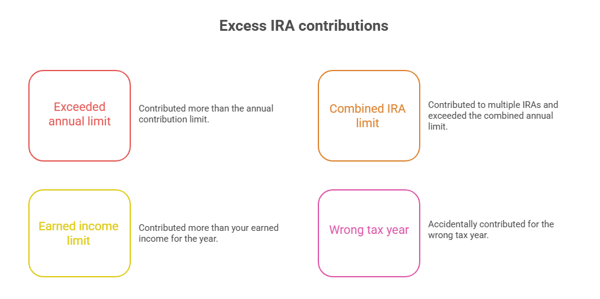
Contribution limits can change from year to year, so it's a good idea to verify the current limit before contributing. You can contribute up to the annual limit or your earned income, whichever is lower. Earned income includes wages, salaries, tips, self-employment income, etc. Passive Income such as investment income, rental property income, retirement income, and Social Security are considered unearned income. If you do not have any earned income, you cannot contribute to an IRA.
You may have an excess contribution if you:
How do I fix an excess contribution?
If you discover the mistake before the tax filing deadline, contact your IRA custodian as soon as possible and request a return of excess contributions. It's important that the distribution is processed specifically as a return of excess contributions.
When handled correctly:
- The excess contribution itself generally isn't taxable because it was made with after-tax dollars.
- Any earnings attributable to the excess contribution must also be withdrawn.
- Those earnings are generally taxable.
Example: Suppose you contributed $9,000 to your traditional IRA, but the contribution limit for the year was only $7,000.
You contact your IRA custodian before the tax filing deadline (or the extension deadline if you filed an extension) and request a return of your excess contribution. While the money was in the account, it earned $150.
You receive:
- Your $2,000 excess contribution, which isn't taxable.
- $150 of earnings, which are taxable. By correcting the excess contribution before your tax filing or extension deadline, you can avoid the 6% excise tax.
What if I miss the tax filing deadline?
If you don't correct the excess contribution before your tax filing deadline, you still have options, but the process becomes more complicated.
In most cases, the IRS assesses a 6% excise tax on the excess contribution for each year it remains in your IRA. You'll report this penalty on Form 5329 when you file your tax return.
The good news is the penalty doesn't last forever. You can stop future 6% penalties by removing the excess contribution or, if you're eligible, applying it toward a future year's contribution limit. However, you'll still owe the penalty for each year the excess remains in your account.
💡 Note: After the tax filing deadline, don't simply withdraw money from your IRA on your own. A regular distribution isn't the same as correcting an excess contribution. Contact your IRA custodian to make sure the transaction is handled correctly.
What happens if I do nothing?
If you leave the excess contribution in your IRA, the IRS assesses a 6% excise tax each year the excess remains in the account.
The penalty continues until the excess contribution is corrected, so it's usually best to address the issue as soon as you discover it.
How do I report this in FreeTaxUSA?
If you made an excess contribution, or corrected one, enter your IRA contribution information by following the menu path:
Deductions/Credits > Common Deductions/Credits > IRA Contributions
Enter all contributions made throughout the year including any excess. The software will calculate any excess contribution and ask if you withdrew the excess. If you have withdrawn the excess prior to filing, answer Yes and enter the amount withdrawn.
FreeTaxUSA will determine if Form 5329 is required based on the information you enter and will prepare it automatically.
If you withdraw an excess contribution, your custodian will issue Form 1099-R reporting the corrective distribution. The form may not be issued until the following January, even if you withdraw the excess before filing the tax return. When the form is received, enter it into FreeTaxUSA.
If the distribution includes earnings, those earnings are taxable for the year in which the excess contribution was made, even if the withdrawal occurred in the following year. If you received the 1099-R in the following year and it reports earnings that were not included on your original return, you will need to amend your prior-year return to include the earnings.
💡 Note: The excess contribution itself is not taxable when it is timely withdrawn.
Summary
Overcontributing to a traditional IRA is a common mistake, but it's usually easy to fix if you act before the tax filing deadline. If you miss the deadline, you may owe a 6% excise tax, but you can still correct the excess and stop future penalties.
If you're unsure how to proceed, contact your IRA custodian before taking a distribution.